Compatible System Portfolio
Product Description
Functional Positioning and Target Users in Posterior-Stabilized Knees
The Tibial Insert (PS) is engineered specifically for cases in which the posterior cruciate ligament (PCL) is sacrificed, fulfilling a critical role in posterior-stabilized total knee arthroplasty. Intended primarily for orthopedic surgeons and medical institutions working with knee replacement implant prosthesis solutions, this component complements existing femoral systems to restore knee stability and motion control. As part of total knee replacement implant manufacturers’ offerings, it targets complex primary and revision surgeries where precise soft tissue balancing and implant longevity are essential for patient recovery and functionality. This component assists in substituting ligament function, thereby facilitating enhanced joint stability in clinical applications.
Technical Features and Measurable Specifications of the Tibial Insert (PS)
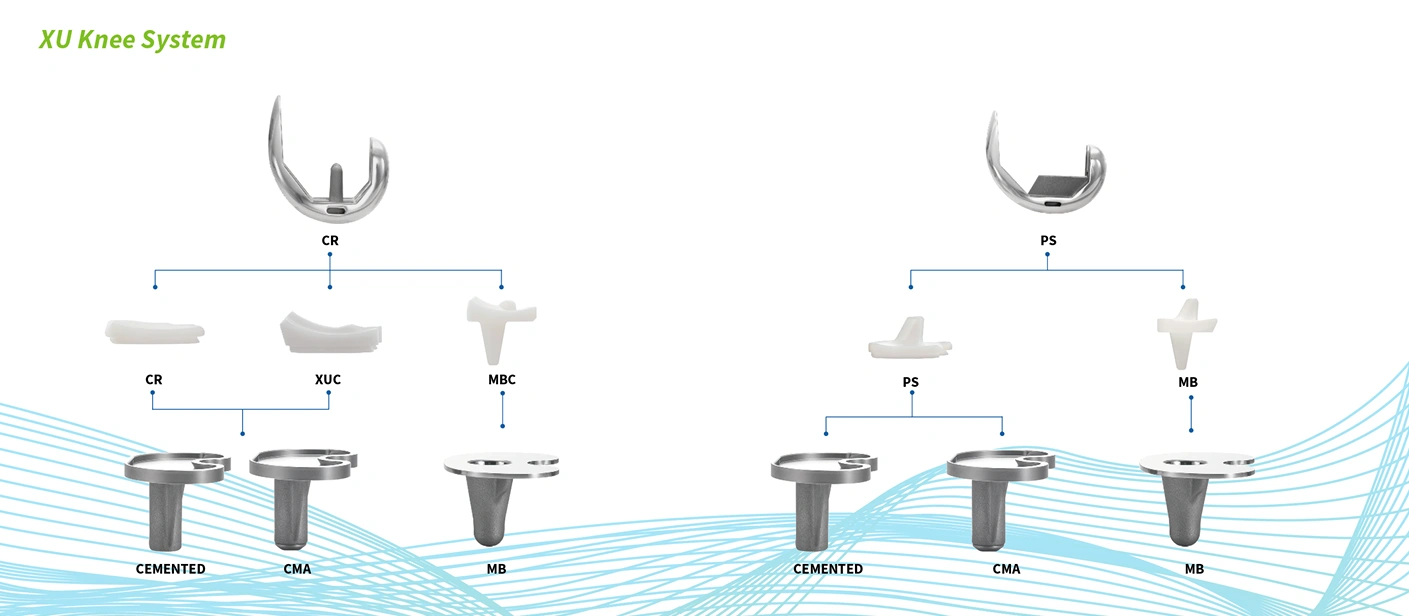
Constructed from highly cross-linked polyethylene (XPE), the Tibial Insert (PS) incorporates an advanced post-cam mechanism engineered to replicate posterior cruciate ligament constraints. The design includes a 1.5° posterior slope integrated within the implant geometry to optimize kinematics and reduce contact stress. Thickness options ranging from 9mm to 18mm, in consistent 1mm increments, enable fine-tuned intraoperative gap balancing. Additionally, the curve-on-curve articulation surface geometry minimizes polyethylene wear and contributes to implant durability. Compatibility with specific XU Knee System PS femoral components and cemented tibial baseplates ensures seamless modular integration, qualifying it as a reliable element in comprehensive knee replacement implant prosthesis solutions.
Industry Applications and Real-World Clinical Value
The Tibial Insert (PS) finds application primarily in orthopedic surgical settings focused on posterior-stabilized total knee arthroplasty, serving both primary and revision procedures. Its performance characteristics render it suitable for treating knee osteoarthritis with compromised ligament function, where enhanced knee flexion and extension control are required. It supports the efforts of total knee replacement implant manufacturers to provide durable solutions that balance soft tissue and maintain joint stability. Through improved biomechanical stability and wear resistance, this tibial insert contributes significant long-term value by reducing revision rates and supporting effective postoperative mobility, thus aligning with industry standards for knee replacement implants.
Product Overview
The Tibial Insert (PS) is designed for posterior-stabilized total knee arthroplasty, providing stability and kinematic control when the posterior cruciate ligament is sacrificed.
The insert incorporates an optimized post-cam structure that works with the PS femoral component to reproduce the stabilizing function of the PCL during knee flexion and extension.
Through optimized articulation geometry and contact mechanics, the PS tibial insert helps reduce stress concentration, improve stability, and support long-term wear performance.
Product Advantages
Design and Structural Advantages Enhancing Integration
The Tibial Insert (PS) features an optimized post-cam design integrated into a posterior-stabilized system architecture, allowing for controlled anterior-posterior stability and rotational alignment. Its modular design supports precise thickness increments from 9mm to 18mm, enabling versatile intraoperative adjustments to soft tissue tension. The polyethylene material is highly polished to reduce backside wear, complemented by curve-on-curve articulation surfaces that minimize contact stress concentration. This design synergy provides knee replacement implant companies the ability to offer a compatible, reliable component that integrates cohesively with XU Knee System PS femoral components and cemented tibial baseplates. This reliability ensures consistent implant fit and performance in a variety of surgical protocols.
Performance and Usability Benefits for Surgical Outcomes
From a clinical performance perspective, the Tibial Insert (PS) delivers consistent biomechanical stability to mimic natural knee function when the PCL is absent. Its adjustable thickness options simplify intraoperative balancing, reducing procedural complexity and allowing surgeons to tailor fit to patient anatomy. Enhanced wear resistance from cross-linked polyethylene extends implant longevity, which supports value optimization from total knee replacement implant manufacturers’ viewpoints. The ease of integration with widely used knee replacement implant prosthesis systems ensures operational efficiency within surgical workflows. Consequently, this component improves surgical precision, reduces revision probability, and enhances overall patient functional outcomes over the implant lifecycle.
Product Features & Clinical Benefits
Optimized Post-Cam Stability Design
- Designed to work with PS femoral components.
- Provides anterior-posterior stability after PCL sacrifice.
- Optimized post-cam contact reduces excessive stress during flexion.
Curve-on-Curve Articulation Design
- Optimized femoral condyle and tibial insert radius matching improves contact mechanics.
- Helps reduce contact stress and polyethylene wear.
- Supports smooth knee movement throughout the range of motion.
Enhanced Rotational Stability
- Optimized articulation geometry allows controlled internal and external rotation.
- Supports physiological knee movement during daily activities.
Multiple Thickness Options
- Provides multiple insert thickness choices.
- Supports intraoperative adjustment of flexion and extension gaps.
- Facilitates accurate soft tissue balancing.
Wear Reduction Design
- Highly polished surface minimizes backside wear.
- Optimized bearing design contributes to improved polyethylene durability.
| Category |
Specific Description |
| Posterior slope |
1.5° built-in slope for both PS and CR tibial inserts, applicable for 0° horizontal resection |
| Thickness increment |
Consistent 1mm thickness step |
| Thickness selection |
Diverse thickness options to simplify intraoperative flexion and extension gap balancing |
Surgical Applications
Indications:
- Primary Total Knee Arthroplasty (TKA)
Surgical Technique:
- Posterior-stabilized (PS) procedure
- Posterior cruciate ligament (PCL) sacrificed
Compatible Components:
- XU-Knee Femoral Component (PS)
- XU-Knee Tibial Baseplate
Typical clinical applications include:
- Primary knee osteoarthritis
- Degenerative joint disease
- Cases requiring PCL substitution
Specifications
| Parameter |
Description |
| Product Type |
Tibial Insert (PS) |
| Application |
Primary Total Knee Arthroplasty |
| Design Type |
Posterior-Stabilized |
| Surgical Technique |
PCL Sacrificed |
| Compatible Femoral Component |
Femoral Component (PS) |
| Material |
PE/XPE |
| Thickness Options |
Multiple options available |
Product Value & Purchasing Information
System Compatibility & Complete Solution
- Designed as part of the XU-Knee Primary Knee System.
- Compatible with PS femoral components and cemented tibial baseplates.
- Provides a complete posterior-stabilized reconstruction solution.
Product Quality & Reliability
- Optimized post-cam design improves knee stability.
- Advanced articulation geometry reduces contact stress.
- Wear-reduction design supports long-term implant performance.
Supply & Delivery Support
- Stable manufacturing capacity and long-term supply assurance.
- Comprehensive technical documentation support.
- Available product information includes:
- Product specifications
- Sterilization information
- Product labeling
- Batch traceability documentation
FAQ
What materials are used in the Tibial Insert (PS) for knee replacements?
We use polyethylene (PE) and highly cross-linked polyethylene (XPE) in the Tibial Insert (PS). These materials provide excellent wear resistance and durability, ensuring long-term performance in total knee replacement implants.
Can you customize the Tibial Insert (PS) thickness to suit different patient needs?
Yes, we provide the Tibial Insert (PS) in thicknesses ranging from 9mm to 18mm, adjustable in 1mm increments. This range allows surgeons to achieve precise soft tissue balancing during surgery for better patient outcomes.
Is the Tibial Insert (PS) compatible with other components from the XU Knee System?
Our Tibial Insert (PS) is specifically designed for compatibility with the XU Knee Femoral Component (PS) and cemented tibial baseplates. Ensuring this compatibility maintains implant stability and performance in posterior-stabilized total knee arthroplasty.
What support do you offer for ordering and technical inquiries about your knee replacement implant prosthesis?
We provide dedicated technical assistance and production support tailored to your needs. Our team can help with specifications, compatibility, and logistics to ensure a smooth procurement process of your total knee replacement implant prosthesis.


