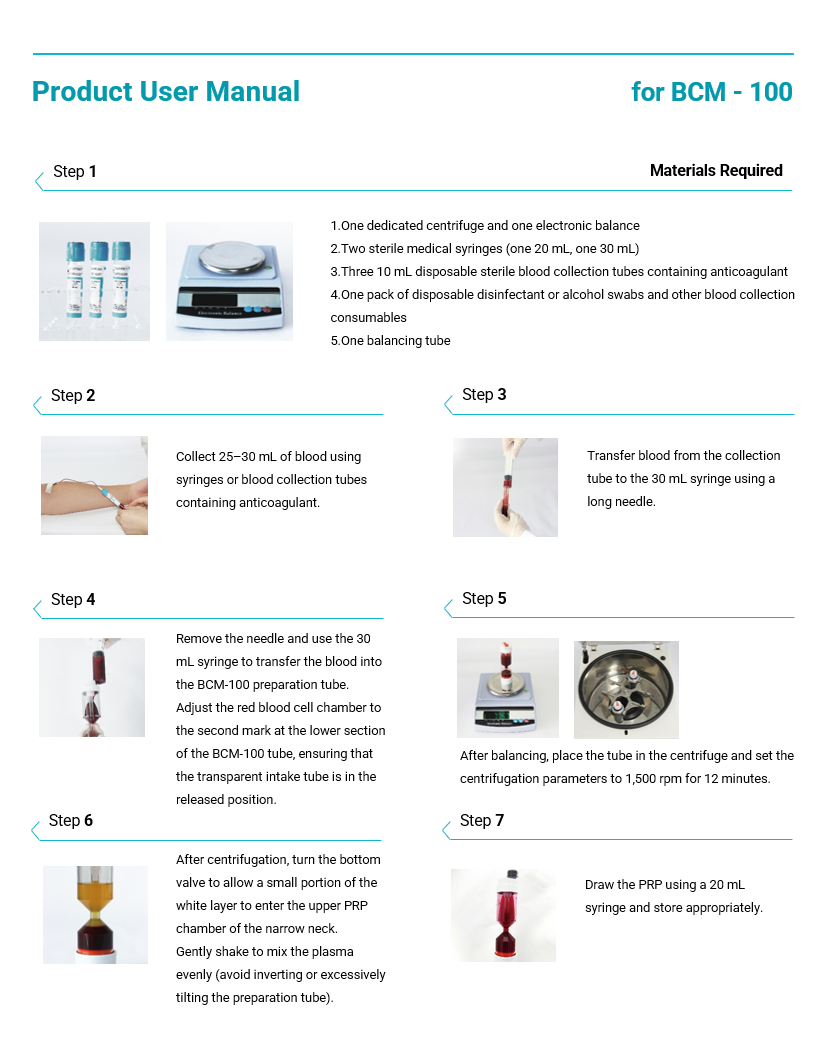
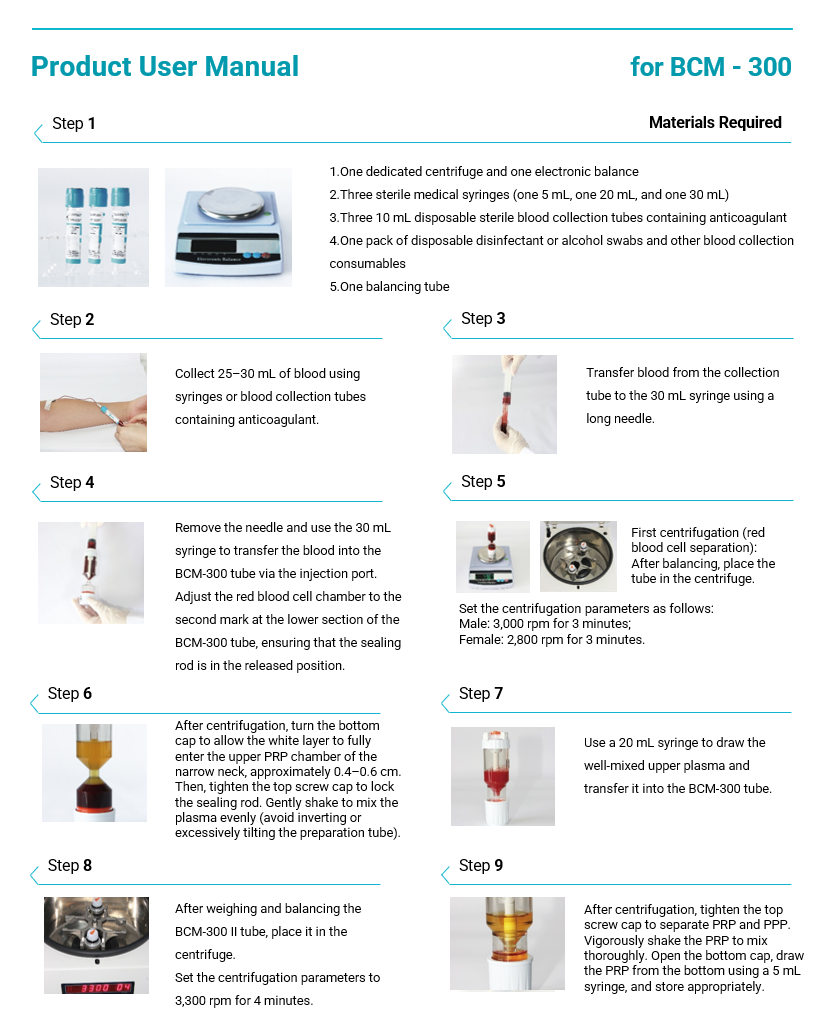
The primary function of the Platelet-Rich Plasma (PRP) Preparation System is to isolate platelet concentrates from autologous whole blood through centrifugation.
The basic principle is based on the different sedimentation rates of blood components—including white blood cells, red blood cells, and platelets—under centrifugal force. After centrifugation for a defined period, the formed elements of whole blood separate into distinct layers.
The PRP preparation process relies on centrifugal separation, which uses differences in density and sedimentation rates among blood components.
Blood Collection
A controlled volume of autologous venous blood is drawn into a sterile PRP preparation syringe or tube.
Centrifugation
The sample is spun at a predefined speed and duration, separating the blood components into three distinct layers:
• Bottom Layer: Red Blood Cells (RBCs)
• Middle Layer: Platelet-Rich Plasma (PRP)
• Top Layer: Platelet-Poor Plasma (PPP)
PRP Isolation
The system's structural design enables precise extraction of the platelet-rich layer while minimizing contamination from red blood cells (RBCs) or leukocytes.
Activation and Application
Upon activation, platelets release regenerative growth factors involved in healing and tissue regeneration.

Upon activation, platelets release a variety of growth factors, including TGF-β, PDGF, VEGF-A, EGF, IGF, and bFGF. Their primary functions are outlined below.
| Growth Factor | Full Name | Primary Functions |
|---|---|---|
| TGF-β | Transforming Growth Factor-β | Plays an important role in inflammatory regulation, tissue repair, and embryonic development. It is recognized as a platelet-derived growth factor with beneficial effects during the healing process. |
| PDGF | Platelet-Derived Growth Factor | Stimulates osteoblasts to secrete collagen and glycoproteins, contributing to bone matrix formation and mineralization. Promotes cartilage formation and intramembranous ossification. Enhances mitosis, capillary formation, and dermal stromal regeneration. Induces fibroblasts to secrete TGF-β1, supporting wound repair and regeneration. |
| VEGF-A | Vascular Endothelial Growth Factor-A | Stimulates endothelial cell proliferation and angiogenesis. Promotes neovascularization and vascular reconstruction at wound sites. Supports endochondral and subperiosteal bone formation. Enhances blood supply to hair follicles and supports hair follicle growth. |
| EGF | Epidermal Growth Factor | Promotes epidermal cell proliferation and differentiation. Stimulates fibroblasts to accelerate fibrin and collagen synthesis. Supports granulation tissue formation and helps reduce scar formation during wound healing. |
| IGF | Insulin-Like Growth Factor | Induces fibroblast chemotaxis and collagen synthesis. Promotes cartilage matrix formation and supports cell proliferation and differentiation. Contributes to wound repair and tissue regeneration. |
| bFGF | Basic Fibroblast Growth Factor | Stimulates fibroblast proliferation, differentiation, and tissue formation, including bone and cartilage. Acts synergistically with VEGF to promote angiogenesis and wound healing. Supports differentiation of hair follicle stem cells. |
• Simple and Efficient Design: Simple structure, quick preparation, effective sealing, and a leak-resistant design.
• High Platelet Enrichment and Recovery: The unique design concentrates platelets in the middle section of the syringe to achieve high platelet enrichment and recovery.
• Adjustable Platelet Concentration: Allows platelet concentration to be adjusted for convenient operation.
• Reduced Red Blood Cell Contamination: Red blood cells are separated into the lower chamber to minimize contamination.
• Moderate Blood Collection Volume: Designed to support efficient preparation with a moderate blood collection volume.
| Model / Specification | BCM-100 | BCM-300 |
|---|---|---|
| Blood Collection Volume | 25–30 mL | 25–30 mL |
| PRP Yield / Volume | 10–13 mL | 3–5 mL |
| Platelet Enrichment Factor | >1.5× | 4–6× |
| Platelet Recovery Rate | ≥80% | ≥60% |
| Centrifugation Time | Single spin, 12 min | Double spin, 7 min |
| White Blood Cells (WBC) | Removal rate up to 71% ± 11% | Recovery rate: 54% ± 19% |
| VEGF-A Enrichment Factor | 3.67 ± 1.30× | 11.196 ± 2.029× |
| PDGF-BB Enrichment Factor | 2.918 ± 0.514× | 6.986 ± 2.427× |
| TGF-β1 Enrichment Factor | 2.324 ± 0.778× | 3.216 ± 0.885× |