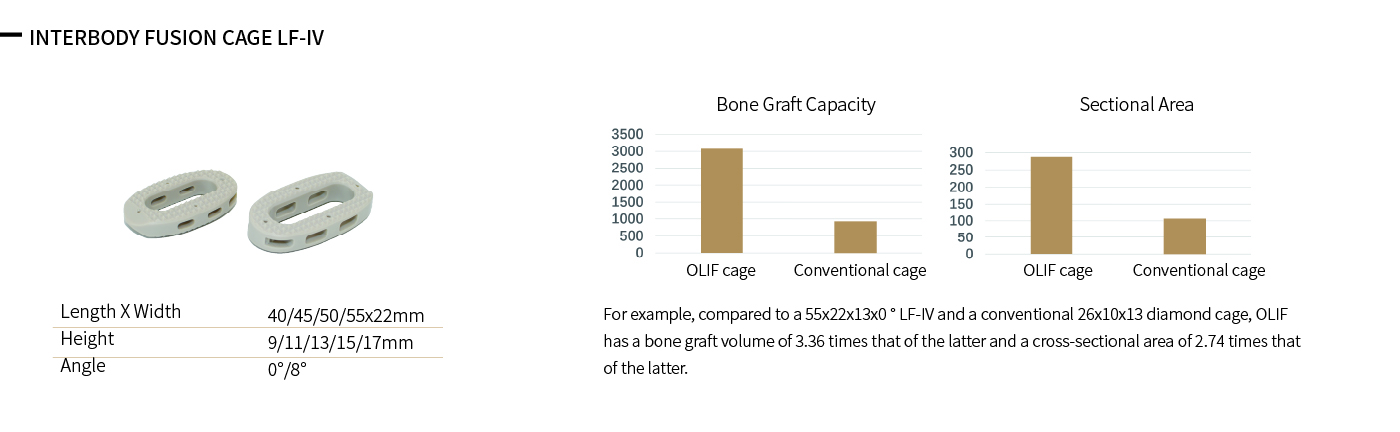
The Oblique Lateral Interbody Fusion (OLIF) Cage is manufactured from radiolucent PEEK (polyetheretherketone) with integrated tantalum radiopaque markers for accurate intraoperative positioning and postoperative imaging.
The cage is designed for implantation between lumbar vertebral bodies through an oblique lateral approach, utilizing a natural anatomical corridor to help minimize muscle and nerve disruption. Its distraction-compression stabilization design provides immediate segmental stability, resistance to rotational and shear forces, and a suitable environment for intervertebral fusion.
• Wedge-shaped or parallel endplates are designed to match different vertebral endplate anatomies.
• Multiple shapes and sizes, including cylindrical and rectangular profiles with angled tips, provide flexibility for different surgical requirements.
• Serrated upper and lower surfaces enhance initial fixation and help prevent cage migration.
• The central graft window provides sufficient space for autologous bone or bone substitutes to support fusion.
• Bullet-shaped leading edge facilitates smooth insertion through the oblique anatomical corridor.
• Tantalum markers enable clear implant identification and positioning under fluoroscopy or X-ray.
• PEEK provides radiolucency, mechanical strength, and excellent imaging compatibility, supporting long-term implantation.
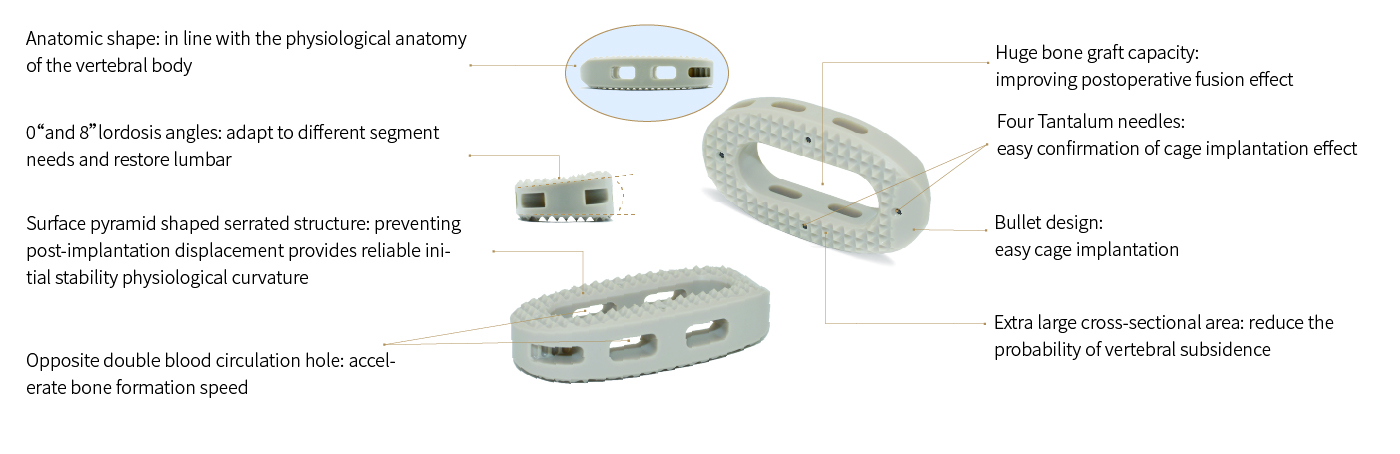
• Minimally Invasive Compatibility: Designed for the oblique lateral approach to help reduce tissue trauma and support recovery.
• Bullet-Nose Design: Facilitates smooth cage insertion with reduced tissue disruption.
• Anatomical Fit: Wedge and flat surface options accommodate different vertebral anatomies.
• Large Graft Window: Provides sufficient space for bone graft material to support fusion.
• Multiple Sizes: Available in various sizes to meet different clinical and anatomical requirements.
• Bone-Like Elastic Modulus: PEEK has an elastic modulus similar to bone, helping reduce stress shielding and support osseointegration.
• Clear Imaging: Radiopaque markers facilitate accurate intraoperative positioning and postoperative monitoring.
The OLIF cage is intended for use with supplemental internal fixation systems in lumbar interbody fusion procedures for:
• Lumbar disc herniation
• Degenerative disc disease
• Disc space narrowing
• Revision surgery following failed discectomy or postoperative spinal instability