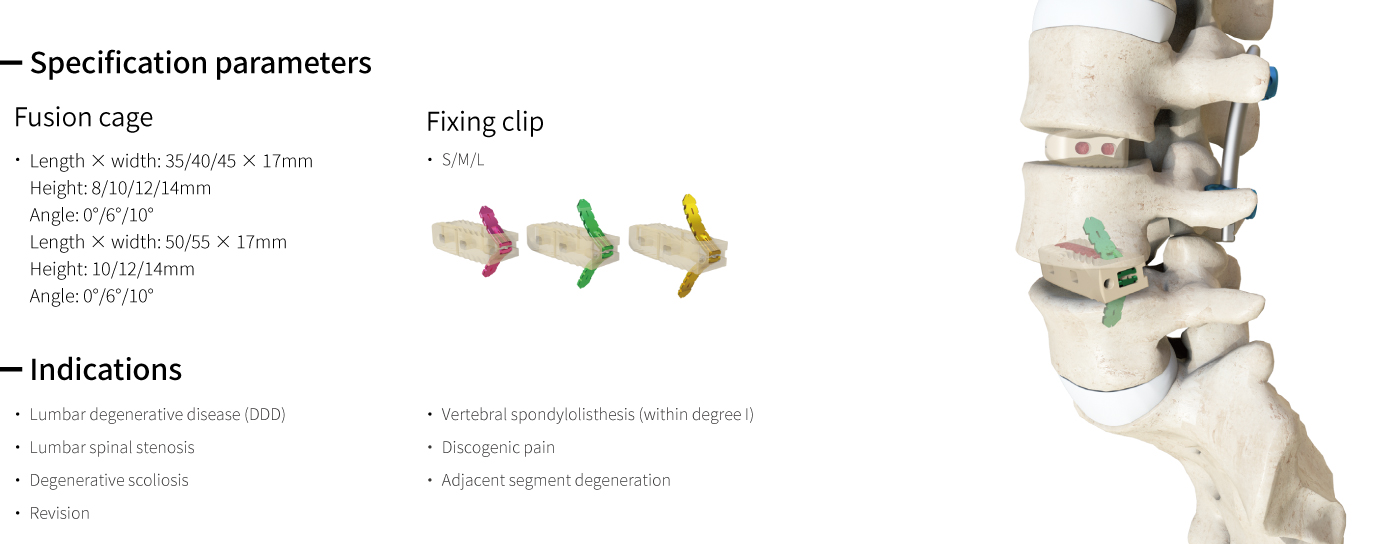
The Uni-L Self-Stabilizing Lumbar Interbody Fusion Cage is a PEEK (polyetheretherketone) interbody device incorporating pure tantalum radiopaque markers and two titanium alloy locking clips.
Available in multiple footprints and heights, the cage is positioned between adjacent lumbar vertebral bodies and secured using a dual-clip self-locking mechanism. Its distraction-compression stabilization design generates opposing forces to resist shear and rotation while transferring axial loads.
The system provides immediate postoperative segmental stability and supports restoration of disc height and lumbar lordosis. The hollow internal chamber allows sufficient space for bone graft material to support the fusion process.
• Vertical clips engage the adjacent vertebrae to help prevent micromotion and implant migration.
• The cage is positioned completely within the disc space without external protrusion, helping minimize soft tissue irritation and potential adjacent-segment complications.
• Serrated surfaces provide frictional engagement with the vertebral endplates to enhance initial mechanical stability.
• Integrated tantalum markers facilitate intraoperative positioning and postoperative imaging evaluation.
• PEEK has an elastic modulus closer to cancellous bone, helping reduce stress shielding and support bone integration.
• The cage is designed to withstand long-term axial loading during the fusion period.
• PEEK provides biocompatibility suitable for long-term implantation.
• The radiolucent PEEK structure allows clear X-ray and MRI imaging with minimal artifact.
• Two titanium alloy locking clips provide secure fixation and help prevent back-out after implantation.
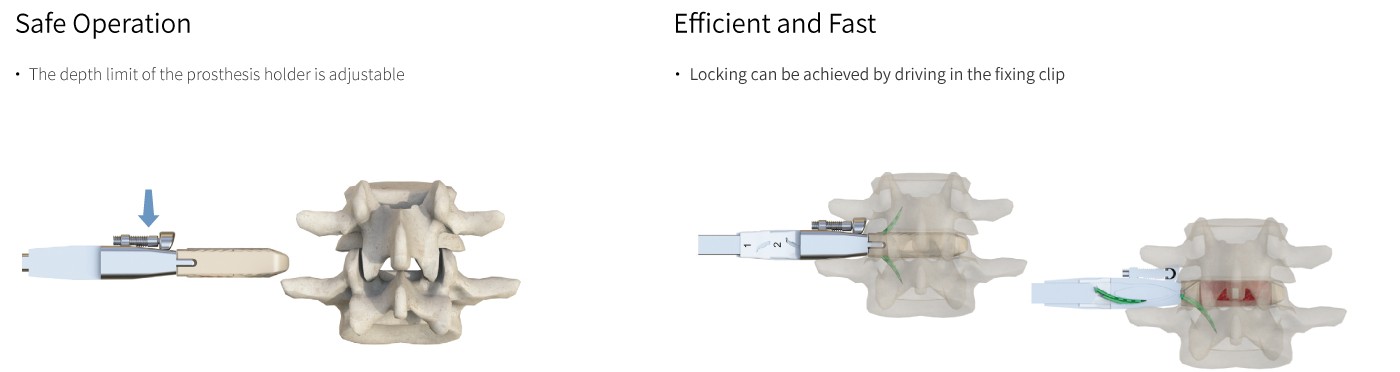
• Minimally Invasive Insertion: The compact cage profile facilitates insertion through a smaller incision, while dedicated instruments allow adjustment of clip depth.
• Customizable Sizing: Multiple cage sizes accommodate different patient anatomies and surgical requirements.
• Reduced Stress Shielding: The bone-like elastic characteristics of PEEK help support a suitable environment for osseous fusion.
• Clear Postoperative Imaging: Radiopaque tantalum markers provide clear reference points for implant positioning and follow-up evaluation.
• No Posterior Instrumentation Required: The stand-alone design eliminates the need for additional pedicle screws or rods, potentially simplifying the procedure and reducing muscle disruption.
• Clip-Only Stabilization: Vertical clip deployment provides fixation while minimizing interference with surrounding posterior soft tissues.
The Uni-L Self-Stabilizing Lumbar Interbody Fusion Cage is indicated for single- or multi-level lumbar anterior interbody fusion in patients with:
• Spinal Instability
• Revision Surgery Following Posterior Discectomy
• Degenerative Disc Disease
• Pseudarthrosis
• Scoliosis
• Recurrent Disc Herniation
The system provides immediate load support, helps maintain disc-space height, and provides mechanical stability during the fusion process.