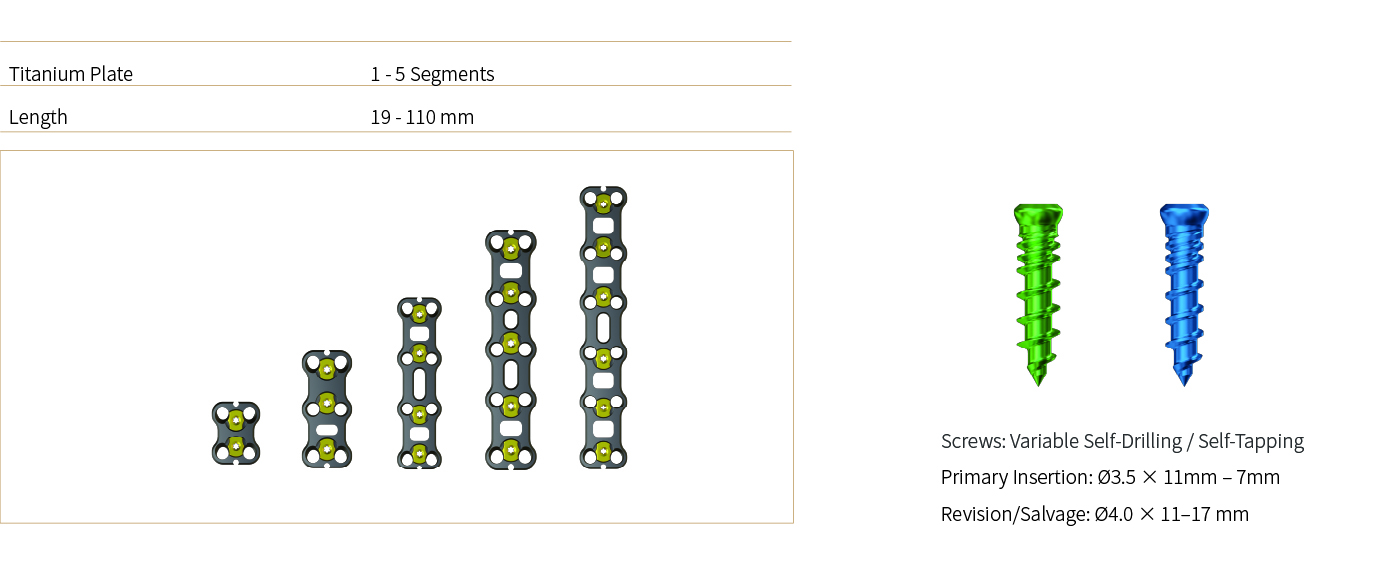
The Anterior Cervical Plate – Type IV is part of an anterior cervical fixation system developed to provide stabilization and support following cervical spinal fusion. The system incorporates a pre-configured locking mechanism and offers both fixed-angle and variable-angle screw options, allowing different fixation configurations for procedures such as ACDF, ACCF, and ACAF.
The plate is placed on the anterior surface of the cervical spine and secured to the adjacent vertebral bodies with screws. By helping maintain vertebral alignment and providing immediate mechanical support, the plate is designed to control excessive segmental movement during the fusion process.
Anterior cervical plates are commonly manufactured from titanium or titanium alloy because of their combination of biocompatibility, mechanical strength, light weight, and corrosion resistance, making these materials suitable for long-term implant applications.
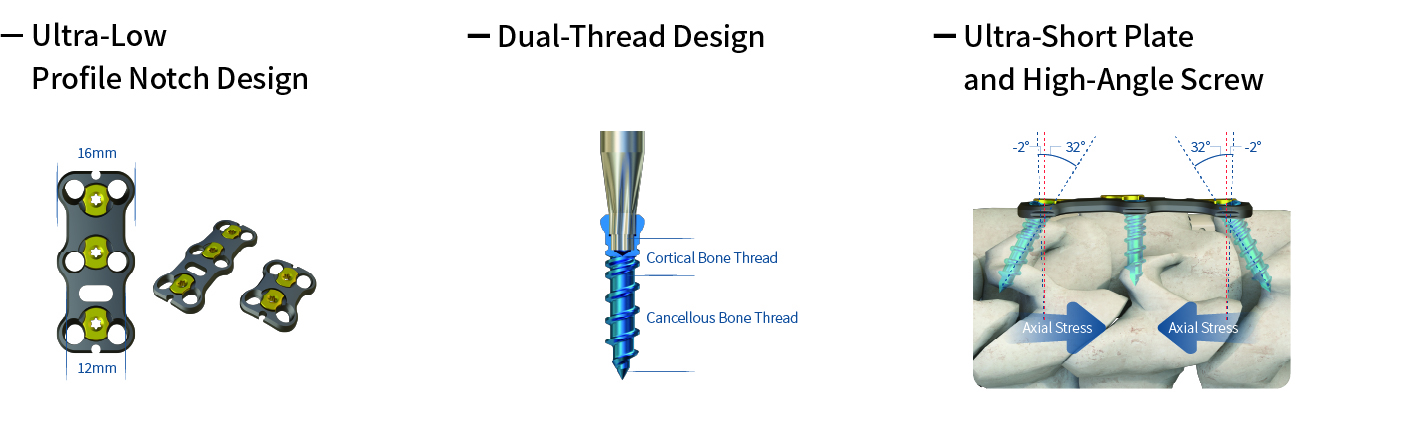
With a plate thickness of approximately 1.8 mm and a narrow width of 12/16 mm, the low-profile configuration is designed to minimize implant prominence and help reduce the potential for postoperative dysphagia.
The short plate design helps minimize interference with adjacent cervical segments.
Highly divergent screw trajectories provide greater flexibility in fixation and are designed to support the mechanical environment required for bone fusion.
Approximately 3 mm of cortical thread is provided at the screw tip to increase engagement with the anterior cortical bone of the vertebral body.
The screw configuration is designed to improve bone purchase and contribute to fixation stability.
Enhanced Fixation: Angled screw placement combined with tension-band mechanics strengthens the relationship between the plate, vertebrae, and bone graft, supporting a stable fixation construct.
Anti-Back-Out Design: The locking configuration is designed to help prevent screw back-out and maintain construct integrity during cervical motion.
Dynamic Mechanical Support: During cervical flexion, the plate provides structural support, while during extension it functions as a tension-band structure to contribute to segmental stability.
Immediate Stabilization: The fixation construct provides immediate postoperative mechanical support and may reduce the need for prolonged external immobilization.
Multiple Plate Configurations: Plate options are available for 1- to 5-level applications to accommodate different surgical requirements and anatomical conditions.
Flexible Screw Selection: Both fixed-angle and variable-angle screws are available, providing fixation options for different bone conditions and surgical preferences.
TC4 Titanium Alloy: All components are manufactured from TC4 titanium alloy, combining biocompatibility, mechanical strength, and corrosion resistance.
TC4 Titanium Alloy: All components are manufactured from TC4 titanium alloy, providing the material characteristics required for implantable cervical fixation components.
Ultra-Low Profile: The 1.8 mm plate thickness and 12/16 mm width create a compact profile designed to minimize implant prominence.
Divergent Screw Configuration: Highly divergent screw trajectories provide flexibility in screw placement and support secure anterior cervical fixation.
Dual-Lead Thread: The screw tip incorporates approximately 3 mm of cortical thread to enhance engagement with the anterior cortical bone.
The Anterior Cervical Plate – Type IV combines a low-profile plate design, divergent screw trajectories, and a secure locking configuration to provide flexible anterior cervical fixation.
Its range of plate lengths and fixed- and variable-angle screw options allows the system to accommodate different cervical fusion procedures and fixation requirements. The TC4 titanium alloy construction further provides the strength and biocompatibility required for implant applications.
• Cervical Spine Trauma
• Degenerative Disc Disease (DDD)
• Cervical Spondylosis
• Cervical Spinal Stenosis
• Cervical Disc Herniation
• Cervical Deformity Correction
• Failed Previous Spinal Surgery
• Spinal Tumors or Infections
Anterior cervical plate fixation may be incorporated into an anterior cervical discectomy and fusion (ACDF) procedure for conditions such as cervical disc herniation or cervical spondylosis.
Under general anesthesia, the patient is positioned supine with the neck appropriately extended. A transverse incision of approximately 3–5 cm is made along a natural skin crease to provide access to the cervical spine. The platysma is dissected and the appropriate tissue planes are gently retracted to expose the prevertebral region.
After radiographic confirmation of the target level, typically within the C3–C7 region, the affected intervertebral disc is removed. Associated osteophytes may then be resected to achieve the required neural decompression.
An interbody graft, such as a PEEK cage or an allograft filled with autologous bone, is placed into the prepared disc space under fluoroscopic guidance. The anterior cervical plate is subsequently positioned and contoured according to the vertebral anatomy before being secured to the adjacent vertebrae using self-tapping locking screws.
The plate-screw construct is designed to provide immediate segmental stabilization, maintain the mechanical support of the interbody graft, and help reduce the risk of graft displacement during the fusion process.
The surgical wound is then closed in layers using absorbable sutures and covered with an appropriate sterile dressing. Postoperative immobilization, rehabilitation, and follow-up should be determined by the treating surgeon according to the patient's condition and clinical requirements.